


How Many Words Are on a Page in a Book? A Complete Guide
Writers and self-publishers often ask how many words are on a page in a book. The answer shapes your manuscript length, your budget, and your printing costs. Most printed books hold between 250 and 300 words per page. That number shifts based on font, spacing, and trim size.
Knowing how many words are on a page in a book helps you plan your project with confidence. This guide breaks down every factor and gives you clear averages. It also shows you how to hit your target page count. Let us walk through the details you need to publish smart.
The Quick Answer on Words Per Page
Most printed books average 250 to 300 words per page. Standard novels sit right near 275 words each. Trade paperbacks often land inside this same range. Publishers use this figure to estimate page count fast. You can multiply your total word count by this average. Better yet, divide your manuscript word count by 275. That gives you a quick page estimate in seconds.
A 75,000-word novel runs close to 273 pages. This simple math predicts your book’s final size. It also guides your pricing and print decisions. Keep this baseline handy as you write and edit your book.
What Affects Words Per Page in a Book
Several factors change your words per page. No single number fits every book on the shelf. Your design choices control the final count. Let us look at the main drivers below.
Trim Size and Page Dimensions
Trim size means the physical width and height of your book. Larger pages simply hold more words. A 6×9 inch book fits more text than a 5×8 inch book. Small trim sizes reduce your word density fast.
Hardcovers and trade paperbacks use different standards. Your genre often dictates the right trim size. Pick a size that matches reader expectations. Clean book formatting keeps your layout tidy and consistent across every page.
Font Choice and Font Size
Font size directly affects your book word count per page. A 10-point font packs in more words. A 12-point font spreads text out wider. Serif fonts like Garamond save space well. Readable fonts also protect your reader’s eyes. Balance density with comfort for the best result. Your font shapes both style and page count. Test a few options before you commit to one.
Line Spacing and Margins
Line spacing controls the gap between each line of text. Tight spacing packs more text onto each page. Wide margins shrink your usable text area. Print books use smaller margins than raw manuscripts. Good spacing improves readability and flow. Smart margins frame your text with care. These small choices add up across hundreds of pages.
Average Words Per Page by Book Type
Different book types carry different averages. Genre and audience drive these numbers. Here is what you can expect on the page.
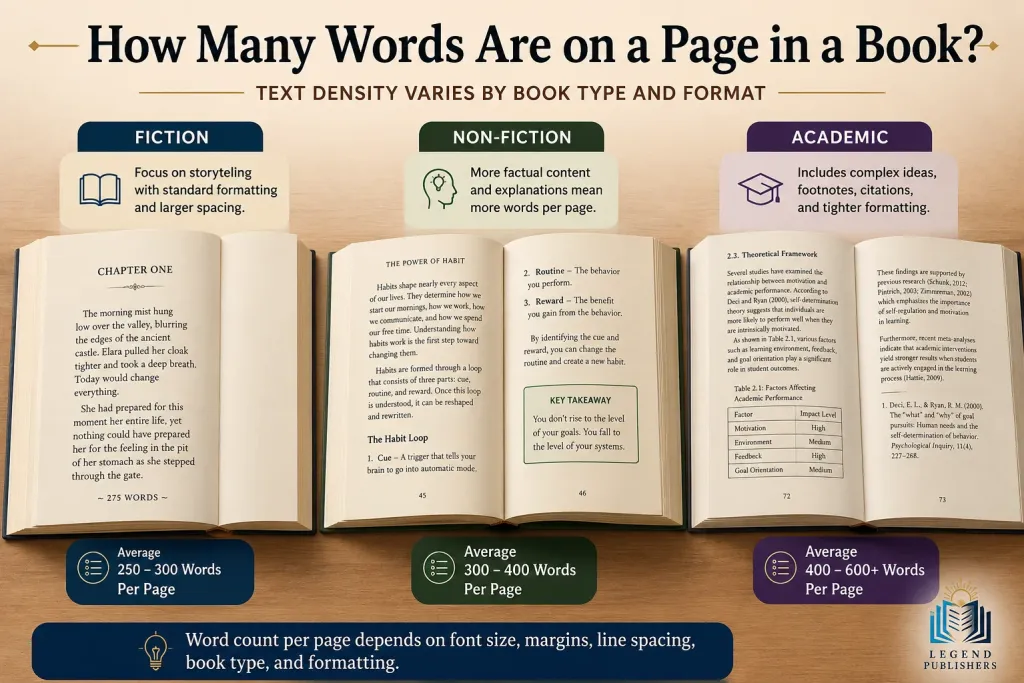
Fiction pages hold around 250 to 300 words. Novels favor dialogue and generous white space. Nonfiction pages often reach 350 to 400 words. Dense text and fewer breaks raise the count. Children’s books hold far fewer words per page. Some picture books use just 10 to 50 words. Textbooks pack in the most text of all. Reference the Word count standards to compare your project.
Words Per Page Versus Total Book Word Count
Words per page and total word count work together. One number helps you estimate the other. Your total manuscript word count sets your page range. A clear target keeps your project on track. Sharp book editing tightens your word count fast. It also trims filler and boosts your pacing.
Book Word Count by Genre
Each genre carries its own word count norms. Standard novels run 70,000 to 90,000 words. Thrillers often reach 90,000 to 100,000 words. Romance novels sit near 50,000 to 90,000 words. Middle-grade books stay under 55,000 words. Fantasy and science fiction climb past 100,000 words. Nonfiction guides average 40,000 to 60,000 words. Match your word count to your genre norms. Readers and agents expect these familiar ranges.
Why Words Per Page Matters for Your Book
Your page density affects real production costs. Page count drives your printing price. More pages mean higher production costs per unit. Spine width also depends on your page count. Your cover design must fit that exact spine.
Smart layout choices save you money. They also improve your reader’s experience. A well-formatted book feels professional in the hand. Readers notice sharp layout right away. They also finish clean books faster. This is why your page count deserves your attention early.
How Many Words Are on a Page in a Book for Different Formats
Format changes your words per page more than most writers expect. Ebooks flow differently than print books. Readers can resize ebook fonts on their devices. That makes fixed page counts less meaningful for ebooks.
Print books lock your layout in place. Audiobooks skip page counts entirely and use runtime. Large-print editions cut that number in half. Each format needs its own layout plan. A skilled team adjusts your book word count for every version. Correct trim sizing also matters here, so review the Book size basics before you print.
How to Calculate Words Per Page for Your Book
You can calculate your words per page in minutes. Start with your total manuscript word count. Choose your trim size and your font next. Then apply the standard average of 275 words. This method gives you a reliable page estimate.
It also helps you plan your book word count early. Accurate numbers prevent costly surprises at the printer. Knowing how many words are on a page in a book makes this step easy. Let us break the formula down together.
A Simple Word Count Formula
Divide your total word count by 275. The result is your estimated page count. Multiply your page count by 275 to reverse it. That shows your target book word count. A 300-page book needs about 82,500 words. A 200-page book needs roughly 55,000 words. Adjust the average for your chosen font. This quick formula keeps your project grounded. A lean book word count often saves you real money.
Common Words Per Page Mistakes to Avoid
Many first-time authors misjudge their words per page. Some pick a font that is far too large. Others ignore trim size during layout. A few forget margins in their estimates. These mistakes inflate your page count fast.
Higher page counts raise your printing costs. Wrong estimates also delay your launch date. Poor planning hurts your page layout too. Professional help removes these risks early. A trained team locks your book word count in place. That step protects your budget and your timeline.
Words Per Page and Your Self-Publishing Budget
Your words per page shapes your entire publishing budget. Print costs rise with every added page. Shipping fees also climb with heavier books. A tight layout keeps your costs low. It also boosts your profit margin per sale.
Careful book proofreading removes bloat and typos. Clean pages read better and print cheaper. A smart book word count pays you back for years. This is why page planning matters so much for authors.
Words Per Page Standards Publishers Expect
Traditional publishers follow strict layout rules. They expect a consistent word count on every page. Literary agents also judge your manuscript by its length. A tidy page count signals a professional author.
Editors calculate your book word count during review. They compare it against clear genre benchmarks. Meeting these standards improves your acceptance odds. Self-published authors gain the very same edge. Clean layout also builds trust with your readers. Legend Publishers applies these exact standards to your project. Understanding how many words are on a page in a book puts you ahead. You then submit a manuscript that looks ready for print.
How Publishers Estimate Page Count
Publishers rely on a fixed average per page. They plug your total into one simple formula. This gives a fast and reliable page estimate. Your book word count drives the whole calculation. Accurate input always means accurate output. A clean manuscript speeds up this process. It also lowers your final editing costs. Trust real experts to handle this math for you.
How Legend Publishers Helps You Nail Your Page Count
Legend Publishers turns your manuscript into a polished, market-ready book. Our team handles layout, spacing, and trim size for you. We match your page layout to industry standards. Our book publishing services cover every single step. Expert designers craft your interior with real care. Skilled editors refine your total book word count.
We also create stunning book cover design that fits your spine. You get a professional book without the guesswork. We handle the technical details so you can focus on writing. Every author deserves a book that looks its best. You always know your page count before we print. Reach out today for a free, no-pressure quote. Let us bring your book to life the right way.
Conclusion
Now you know how many words are on a page in a book. Most books hold 250 to 300 words per page. Font, spacing, and trim size shape that final number. Your genre sets your total word count target.
Smart planning saves you both time and money. Understanding how many words are on a page in a book keeps your project realistic. Legend Publishers makes the whole process simple and stress-free. Trust our team to format and publish your book right. Contact us today and start your publishing journey with confidence.
